Behavioral Design
Interaction Design
UX Research
Reimagining AI coaching for shared gym environments — where the technology stays quiet, the corrections stay private, and the user stays in control.
Role
UX Researcher and Interaction Designer
Timeline
2026, 8 weeks
Team
4 designers, ASU team project
Problem Statement


Where does the help end — and the watching begin?
Smart gym technology often turns support into a public performance. AURA gives users quiet, private guidance they can accept, dismiss, or override at any point.
• Bright screens dominate the gym floor, breaking focus and flow in a shared environment.
• Form corrections appear publicly, leading users to disable feedback rather than be coached in front of strangers.
• Users lose autonomy — they don’t trust AI systems they can’t override, no matter how accurate.

4
team members
8
weeks
4 interviews
8
user flows
The design opportunity
Make coaching feel like a quiet companion — not a public correction system.
Research Process
We began with a value proposition canvas mapping the core tension: traditional gym equipment and screen-heavy smart tech tend to scare, judge, or overwhelm with support. AURA’s opportunity was discreet, confidence-building guidance that adapts to a user’s form and fatigue.
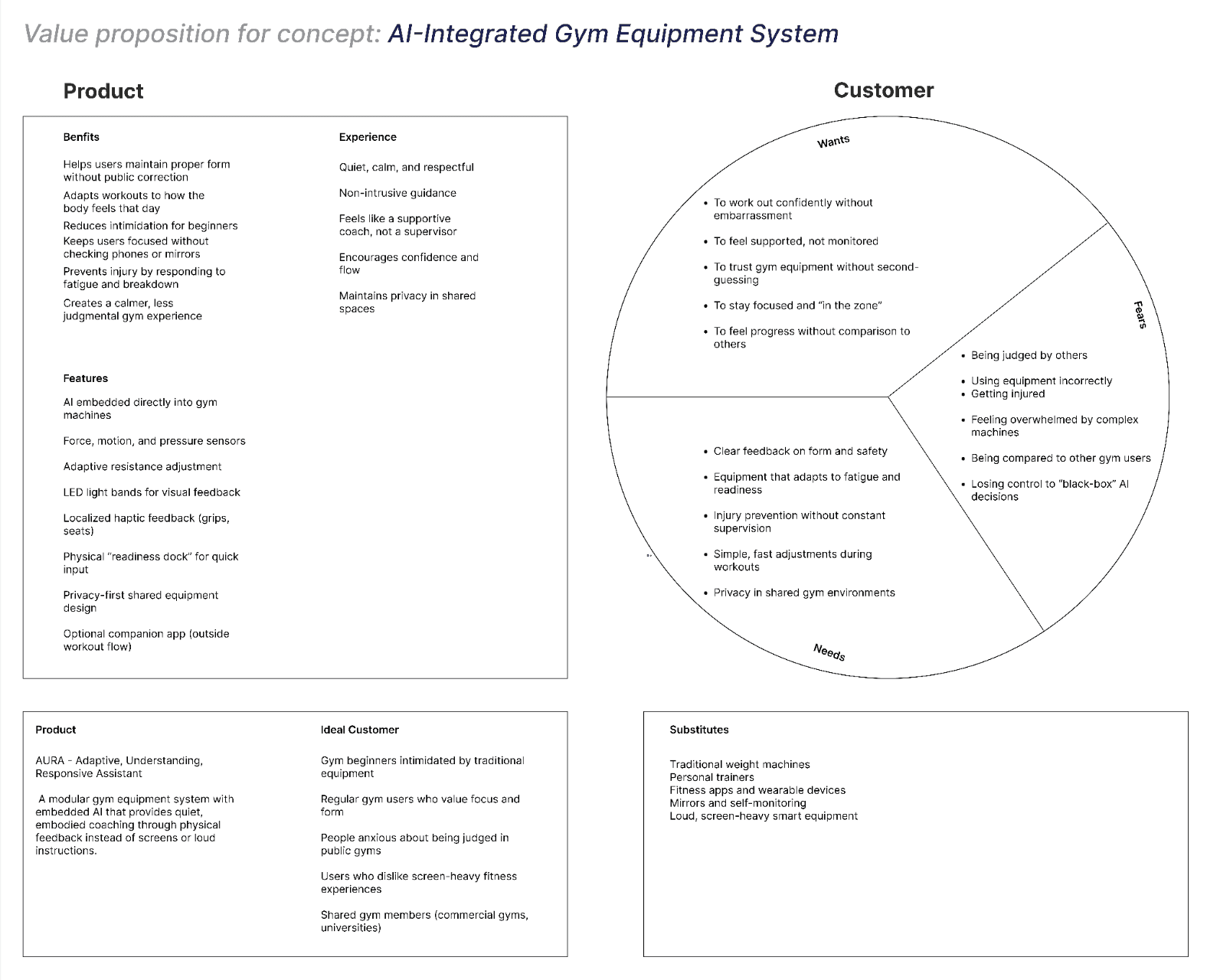
To test that framing, we ran an anonymous survey and interviews with four participants exploring guidance, comfort, and trust in automation.
“I don’t mind the machine helping — I just want to be the one who decides when.”
Synthesized using an AEIOU framework, three patterns emerged:

Internal doubt > judgment
Users fear their own mistakes more than being watched.
Control is non-negotiable
Automation welcome only if it can be overridden.
Quiet feedback wins
Lights and haptics trusted over audio or screens.
User Perspective
Maya
24 · Beginner
Self-conscious. Her fear isn’t being judged by strangers - it’s judging herself. She wants to know she’s doing things right without broadcasting that she’s still learning.
NEEDS · Private form guidance · Reassurance, not correction · No public mistakes
Daniel
32 · Experienced
Mood-driven. Performance shifts day to day; he doesn’t want constant feedback — he wants a system that knows when to stay quiet and out of the way.
NEEDS · Adaptive intervention · Skippable feedback · Trust in his own judgment
Meera
25 · Intermediate
Building confidence, learning by doing. She gains confidence when feedback is clear and loses it when feedback feels like criticism.
NEEDS · Encouraging tone · Progress visibility · Non-comparative feedback
Three personas, each built from a full empathy map, represent the range of people AURA needs to support — different ages, fitness levels, and comfort levels in gym environments.

“We thought users feared being judged by other people. What we learned is they mostly feared judging themselves.”
Finding the Real Fear
Nine opportunities for quieter confidence

Private by default

Quiet intervention

Ask before acting
Encourage, don’t correct
Visible to you
Small signals, big trust
Control comes first
Confidence, not scores
Stay in control
Based on our research, we established three principles that guided every design decision — from how alerts surface, to how progress is displayed, to who gets to see what.
01 · Private by default.
02 · Optional by design.
03 · Overridable at any point.
Rapid Ideation
Before committing to a layout, each feature owner rapidly explored eight rough directions for their core screen — testing how to present real-time feedback, alerts, and progress without overwhelming the user.

Bringing It to Life
Each feature owner storyboarded their concept in a real gym scenario before any screens were drawn — grounding the interaction in a moment, not just a flow.

Testing and Iteration
Before high-fidelity design, we ran a low-fidelity usability test with three participants — one matching Maya, one general, and one matching Daniel — using a think-aloud, Wizard-of-Oz method.

What worked
Scan setup, live tracking, and summary understood without guidance.
What didn’t
The consistency screen read inconsistently for all three participants.
What changed
Redesigned the pre-warning flow, historic trends, and friends-screen interactions.
A consistent design system — dark theme, acid-lime accent, defined color palette, typography scale, and reusable components — was established before high-fidelity screen production began.
Near Black
#0B0C12
Neon Lime
#C9F135
Teal
#0C4E57
Charcoal
#262A2A
Final Experience

AURA
Every project teaches something. These three insights genuinely reshaped AURA mid-process and now define how we think about AI in personal contexts.
Fear was internal
Users mainly feared their own perceived mistakes.
Fear was internal
Users mainly feared their own perceived mistakes.
Control beats intelligence
The most useful automation for an override.
Less is the design
The best feedback often knows when not to appear.
AURA made me think about AI as a practice of restraint. The goal was never to make the gym louder, smarter, or more corrective — it was to preserve the user’s confidence. Designing for privacy meant treating control as a feature, not a fallback. Every alert had to earn its interruption. Good AI design is restraint design.
“Gyms got smart. AURA wants them to get human.”