UX Design
AI Decision sopport
healthcare UX
An AI-assisted triage interface for hematology departments - where every recommendation is explainable, every action is auditable, and the clinician keeps final authority.
Role
UX Researcher and Interaction Designer
Timeline
2026, 8 weeks
Team
2 designers
Tools
OVERVIEW
Haematology triage is manual, inconsistent, and cognitively overwhelming. Nurses face growing patient loads with no standardised support. High cognitive load, unstructured referral data, and a lack of explainable AI make it hard for nurses to triage accurately and consistently.
Our research shows this is not just a clinical problem — it is a design problem. We designed for the workflow first, and the AI second.


Research Process

9
clinical interviews
15
clinician surveys
13
think-aloud sessions
3
post-launch reviews
The design opportunity
Make AI feel like a trusted second opinion - not a black box that nurses have to accept or reject without understanding.
The CHALLENGE
No Decision Support
No Unstructured Data Wasted
Interfaces Add Load
Manual, experience-dependent triage with no consistent system across institutions or shifts.
No tools to extract actionable insights from referral letters at scale.
Existing tools not designed to reduce cognitive load or support fast, confident decisions.
No Clinical Integration
No Explainability
AI tools exist in research but none integrated into real haematology triage workflows.
Black-box AI causes automation bias. Nurses need to verify reasoning, not just accept scores. This is why Triagen exists.
User Perspective
Our primary persona, built from empathy mapping and clinical observation. She represents the core user Triagen
was designed for — and every constraint any clinical AI tool must respect.
S
Processes 30–50 referrals per shift across urgent, semi-urgent, routine, and redirect categories. Over a decade of clinical experience and a low tolerance for tools that slow her down or make decisions on her behalf. She's open to AI — as long as it stays in its lane.
Nurse Sarah
Senior Haematology Triage Nurse
14 years experience
PAIN POINTS
•
Time pressure on incomplete referrals
•
Distrust of opaque AI scores
•
Context-switching between scans and EHR
•
No structured handoff between shifts
•
•
•
•
GOALS
The real design problem
The real design problem wasn't the interface — it was deciding where the tool's responsibility should end and a clinician's should begin.
Design Direction
Every design decision in Triagen maps back to one of three principles. If it doesn't serve one of these — it doesn't ship.
Color-Coded Triage
Dashboard
Transparent AI Reasoning
Nurse Authority
"Why This Urgency?" — individual clinical factors, confidence levels, patient history. Not a score. A case.
Every decision needs a note, a confirmation, and is fully traced. The AI suggests.
The nurse decides. Always.
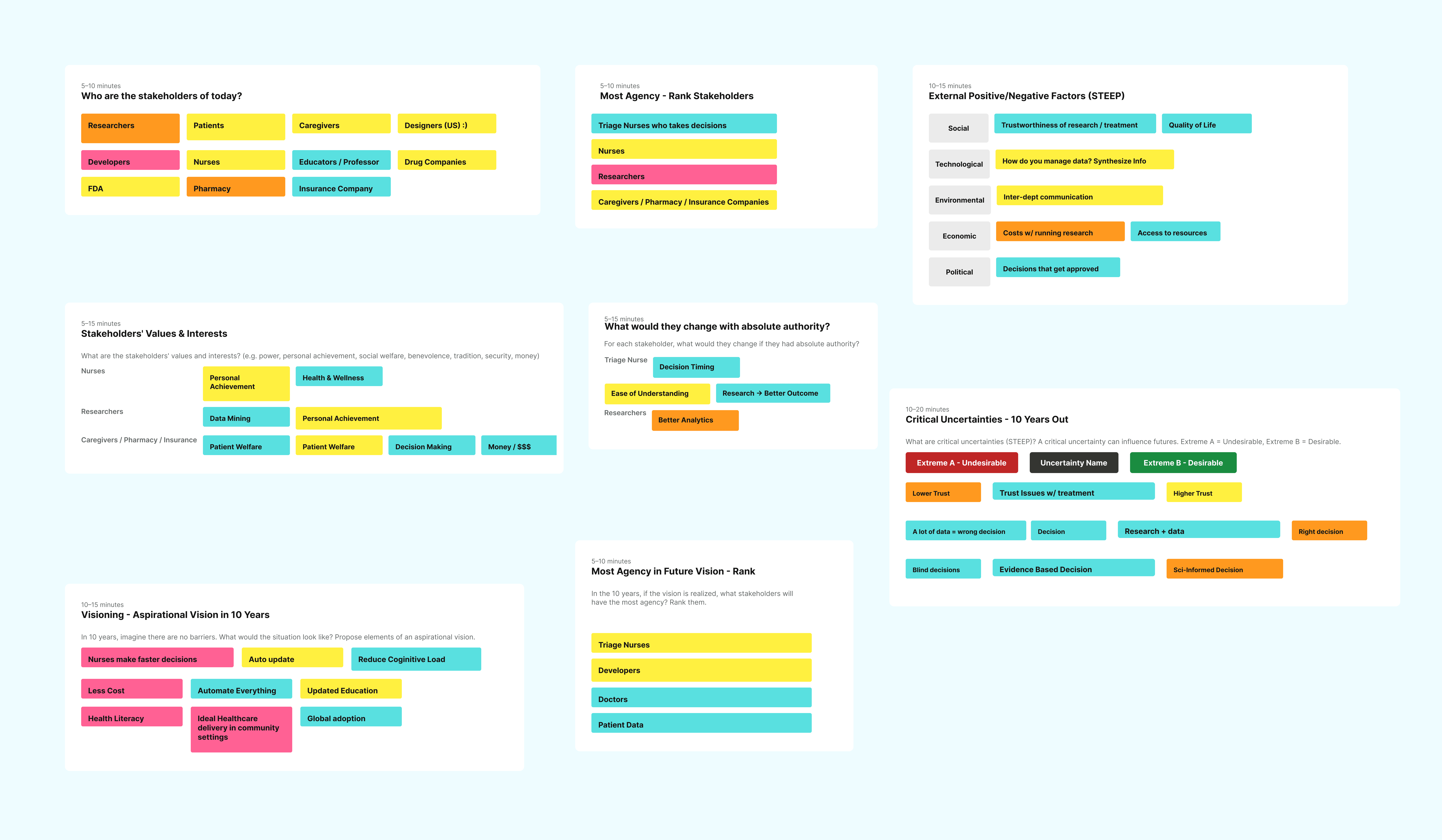
Design Process
We moved through four structured stages, validating each before moving forward. Nothing went to high-fidelity until
low-fidelity testing confirmed the direction.
Expert Feedback
Three domain expert sessions with doctors fundamentally changed our interface direction. What we thought was clear wasn't. What we thought was helpful added load.
01 — AI TRANSPARENCY
Action buttons were unclear. Experts wanted Accept or Modify — with required documentation and explicit authority.
02 - DECISION CLARITY
An AI chatbot added so nurses could ask context questions without leaving the triage flow or breaking concentration.
03 - QUICK INFORMATION


FINAL EXPERIENCE
1.
AI Case Dashboard
A full triage queue that keeps urgency, rationale, timing, and ownership visible at a glance.
Color-coded urgency levels · AI triage decision · Referral reason · Date and status · Assigned clinician
2.
Evidence Cards. Not Black Boxes.
Each clinical factor is surfaced as an individual evidence card, so nurses can verify reasoning—not just receive the result.
Source-linked factors · Plain clinical language · Verify or modify actions · Traceable rationale
3.
Ask AI Assistant
A conversational query interface for the moments when clinicians need a focused answer without leaving the case.
In-context questions · Structured summaries · Urgency counts · No context switching

VISUAL SYSTEM
A design system built for trust and clinical clarity.
Navy · #0F1B2D
Clinical Blue · #2A50BF
Urgency Red · #E84040
Amber · #F0A020
WHAT WE LEARNED
What Triagen taught us about AI in clinical spaces.
Nurses need to verify, not trust.
Trust is earned when the system makes its evidence inspectable.
Control beats intelligence.
Clinicians preferred a useful second opinion over an impressive autonomous answer.
Workflow misfit kills adoption.
Even accurate recommendations fail when they interrupt the rhythm of care.
ANTICIPATED IMPACT
A clearer decision flow for the people and systems around triage.
For Triage Nurses
• Prioritise urgent cases with less searching
• Verify AI reasoning against source evidence
• Keep final clinical authority in the room
For the System
• Make decisions auditable across shifts
• Surface adoption barriers before deployment
• Build a safer path from prototype to practice
REFLECTION
Triagen made the limits of AI feel as important as its capabilities. In a clinical setting, a quieter interface can be more responsible
than a louder one—especially when the person using it carries the consequence of every decision.
The goal was never to make the clinician trust the system blindly. It was to make the system trustworthy enough to question,
verify, and use without surrendering professional judgement.
“The best AI tools don’t liberate.”
They let you decide better.